
隨著人工智慧(Artificial Intelligence, AI)在醫療領域的應用日益普及,全球各國正積極探索如何安全且有效地將AI技術導入臨床照護與醫療決策流程。從醫療器材法規的適切性、醫療科技評估(Health Technology Assessment, HTA)的實證需求,到臨床實務的落地挑戰,AI早已超越單純技術創新,成為攸關病人安全、專業角色轉變與醫療體系永續發展的關鍵議題。
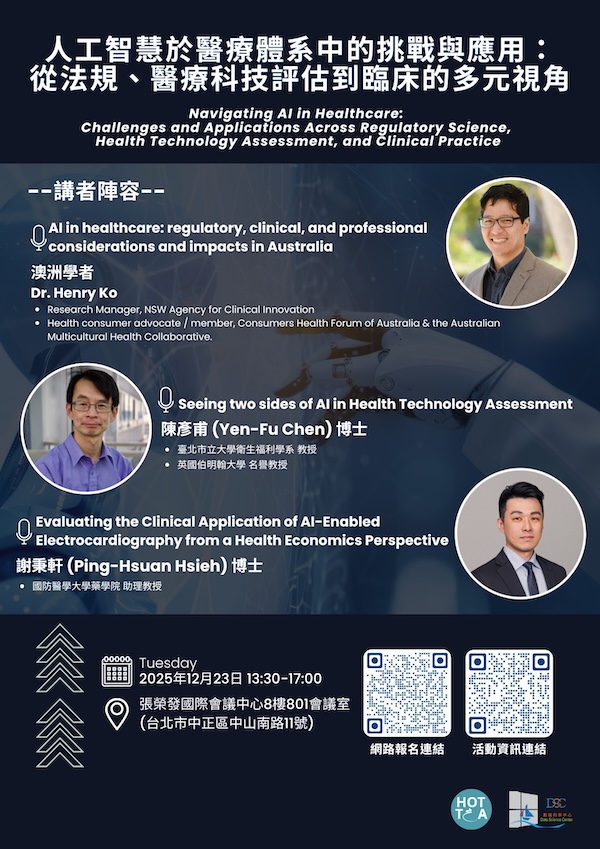
本研討會以「人工智慧於醫療體系中的挑戰與應用:從法規、醫療科技評估到臨床的多元視角」為主題,邀請三位在AI醫療應用與政策評估領域具豐富實務與研究經驗的專家蒞臨分享。首先,來自新南威爾斯臨床創新機構(NSW Agency for Clinical Innovation)的研究經理Dr. Henry Ko,將介紹澳洲AI與軟體類醫療器材的法規監管架構、新南威爾斯州政府的AI評估框架、AI對臨床實務及專業角色的影響,並分享其應用專業及通用AI工具的經驗。第二位講者為現任台北市立大學衛生福利學系教授的陳彥甫博士,過去二十餘年於英國從事HTA與證據整合(Evidence Synthesis)研究,曾主持或參與多項英國國家衛生研究院(National Institute for Health and Care Research, NIHR)資助計畫,並參與多項英國國家健康暨照護卓越研究院(National Institute for Health and Care Excellence, NICE)委託藥品、醫材及軟體類醫材之HTA評估,陳博士將分享其為NICE進行軟體類醫材評估的經驗,以及應用AI工具在其專業領域的實務經驗。最後是由來自國防醫學大學藥學院的謝秉軒博士從健康經濟學的角度切入,介紹國防醫學大學與三軍總醫院團隊共同開發與導入AI心電圖判讀系統的實務經驗,並探討其在臨床應用中進行成本效益分析的設計與結果。
本研討會期盼透過國際經驗與本土臨床應用的交流,深化對AI於醫療體系整合與實施策略的理解,並激發跨領域對話,促進AI技術在醫療場域中的價值評估、風險管理與永續應用,為打造安全、有效且以病人為中心的智慧醫療環境共同努力。
一、 活動日期及時間 Date and Time
2025年12月23日 星期二 13:30-17:00
13:30-17:00, Tuesday, December 23, 2025
二、 活動地點 Venue
張榮發國際會議中心
CHANG YUNG-FA FOUNDATION International Convention Center
三、 地址 Address
台北市中正區中山南路11號8樓801會議室
Room 801, 8F, No.11, Zhongshan S. Rd., Taipei City 10048, Taiwan (R.O.C.)
四、 主辦單位 Host organization
健康效果暨醫療科技教育聯盟
Health Outcomes and Technology Teaching and Education Alliance, HOTTEA
五、 協辦單位 Co-organizers
天主教輔仁大學醫學院 數據科學中心
Data Science Center, College of Medicine, Fu Jen Catholic University
六、 活動聯絡人 Contact
許小姐(02)2905-6221
[email protected]
七、 報名連結 Registration Link
https://forms.gle/jtmhA3EyWHVtSnGy5

八、 報名截止日 Registration Deadline
2025年12月 19日 星期五
Friday, December 19, 2025
九、活動議程 Program
| 時間Time | Duration (mins) | 主題Topic | 講師Speaker(s) | 主持人Moderator |
| 13:30-14:00 | 30 | 報到 Registration | ||
| 14:00-14:10 | 10 | 致歡迎詞 Opening Remarks | 蒲若芳博士 President of HOTTEA CEO, Data Science Center, Fu Jen Catholic University | |
| 14:10-14:50 | 40 | AI in healthcare: regulatory, clinical, and professional considerations and impacts in Australia 【英文演講 English】 | Dr. Henry Ko Research Manager, NSW Agency for Clinical Innovation, Australia | 蒲若芳博士 |
| 14:50 -15:30 | 40 | 從兩個面向看人工智慧在醫療科技評估中的角色 Seeing two sides of AI in Health Technology Assessment 【中文演講 Mandarin】 | 陳彥甫博士 | 蒲若芳博士 |
| 15:30-15:50 | 20 | 休息Break | ||
| 15:50-16:20 | 30 | 從健康經濟學觀點評估人工智慧心電圖之臨床應用 Evaluating the Clinical Application of AI-Enabled Electrocardiography from a Health Economics Perspective 【中文演講 Mandarin】 | 謝秉軒博士 | 蒲若芳博士 |
| 16:20-16:55 | 35 | 綜合討論 Panel Discussion & Q&A | Dr. Henry Ko 陳彥甫博士 謝秉軒博士 楊雯雯研究員 | 蒲若芳博士 |
| 16:55-17:00 | 5 | 閉幕Closing Remark | 蒲若芳博士 | |
十、講師介紹
蒲若芳 (Jasmine Raoh-Fang Pwu) 博士
- 天主教輔仁大學醫學院數據科學中心 執行長
- 健康效果暨醫療科技教育聯盟 理事長
Dr. Henry Ko
- Research Manager, NSW Agency for Clinical Innovation
- Health consumer advocate / member, Consumers Health Forum of Australia & the Australian Multicultural Health Collaborativ
陳彥甫 (Yen-Fu Chen) 博士
- 臺北市立大學衛生福利學系 教授
- 英國伯明翰大學 名譽教授
謝秉軒 (Ping-Hsuan Hsieh) 博士
- 國防醫學大學藥學院 助理教授
楊雯雯 (Wen-Wen Yang) 研究員
- 天主教輔仁大學醫學院數據科學中心 研究員
- 健康效果暨醫療科技教育聯盟 秘書長
十一、演講重點摘要
Dr. Henry Ko
This presentation will provide an overview of how the Australian healthcare landscape is dealing with AI and digital health. Henry will summarise key points and issues about AI in healthcare from four different perspectives in Australia’s healthcare ecosystem:
- a high level overview of the Australian national regulatory framework for AI and medical device software,
- an overview of state public healthcare system policies on AI in healthcare, including the state government’s artificial intelligence assessment framework,
- an overview of how clinicians are considering AI’s impact on their clinical work, and
- for the HTA practitioners in the audience, Henry will provide an overview of his own experiences testing some AI tools used for systematic reviews and health technology assessments.
陳彥甫博士
AI is being adopted in diverse technologies that affect many aspects of our daily life. In health technology assessment (HTA), AI can be seen as playing two major roles: being a health technology to be assessed and being a tool to facilitate the conduct of HTA. In this presentation we will examine AI from these two perspectives through:
- An example of evaluating the use of AI to assist the detection and analysis of lung nodules in computed tomography (CT) scan images as part of a diagnostic technology assessment undertaken for the UK National Institute for Health and Care Excellence (NICE);
- An overview of latest guidance on the use of AI in the process of undertaking evidence synthesis and HTA;
- A brief discussion comparing and contrasting between these two roles of AI in HTA, and possible future directions in research and practice.
謝秉軒博士
This presentation will explore how AI-enabled electrocardiography (AI-ECG) can be assessed and used in clinical practice from a health economics perspective, with examples from Taiwan. It will cover four main aspects:
- Clinical role of AI-ECG in risk prediction and screening
A brief overview of how AI-ECG is used to detect cardiovascular conditions, identify high-risk patients, and support clinical decisions. - Economic evaluation framework for AI-ECG
A concise outline of cost-effectiveness and cost-utility analyses for AI-ECG, including key costs, outcomes, and handling of uncertainty. - Case studies from Taiwan’s healthcare system
Short case examples of AI-ECG in Taiwanese hospitals, focusing on screening in resource-limited areas and mortality risk alerts.